Jake
Co-Owner & Master Craftsman
Deck Design Ideas That Work in Georgia: Features Worth Building
Trends come and go. After 100+ projects around Marietta, Kennesaw, and Woodstock since 2018, we've learned which deck features people are still glad they paid for five years later — and which ones they stop noticing after the first summer. This guide covers the first kind.
The deck features that hold their value in Georgia are the ones you use or look at every single day: a picture-frame border that finishes the deck, a horizontal-slat privacy screen, built-in bench seating, cascading stairs that open the deck to the yard, low-voltage lighting, a railing matched to your view, and a covered or screened section that adds two months to your season. None of these depend on what's fashionable this year.
If you want to see what's currently popular instead, we cover that in our 2026 deck trends post. This post is about the features we'd build on our own houses.
Picture-Frame Borders
A picture-frame border is a perimeter board (often in a contrasting color) that runs around the edge of the deck, with the field boards ending inside it instead of hanging over the rim. It hides cut ends, cleans up the sight lines, and makes even a basic pressure-treated deck look deliberately designed rather than assembled.
It costs a little extra framing and one or two extra boards, not a different budget category. On composite decks it's where a two-tone color scheme earns its keep — a darker border around lighter field boards, or the reverse. You can see the difference it makes in our project gallery.
Horizontal-Slat Privacy Screens
Lots in Cobb and Cherokee counties are often close-set, and a deck that stares straight into a neighbor's kitchen window doesn't get used. A privacy screen fixes that without walling off the whole deck.
The horizontal-slat version — boards run sideways with a consistent gap — blocks the direct sight line while letting air and light through, which matters in a climate that sits above 70% humidity most of the summer. We typically build one panel or one side, not a full enclosure: screen the direction that needs it, keep the view everywhere else.
Built-In Benches and Planters
Built-in bench seating does three jobs at once: it seats people without furniture cluttering the walking space, it defines the edge of a seating zone, and on low decks it can stand in for a railing line. Pair a bench with a built-in planter at each end and you've anchored a corner of the deck permanently.
The honest trade-off: built-ins are fixed. If you like rearranging furniture every season, skip them. If you know where people will sit — facing the yard, near the grill zone — a built-in bench is one of the cheapest ways to make a deck feel finished.
Cascading (Waterfall) Steps
Standard deck stairs are a narrow chute with a railing. Cascading steps — wide stairs that wrap a corner and step down in broad tiers — turn the transition into part of the deck. Kids sit on them, planters live on them, and the deck flows into the yard instead of ending at a gate.
They take more framing and more board footage than a straight stair run, so they cost more. But on decks 2–4 feet off grade, they're often the single upgrade guests comment on. Anything 30 inches or more above grade still needs a guardrail under the code our counties follow, so the cascade works best on the lower drops.
Deck Lighting
A deck without lighting is a daytime deck. Low-voltage LED lighting — recessed into stair risers, under railing caps, or on post caps — extends every evening and makes stairs safer, which matters more than people think on elevated decks.
Our advice: run the wiring during the build even if you're not installing fixtures yet. Fishing wire through a finished deck later is the expensive way to do it.
Railings: Match Them to Your View
Railings are a bigger share of the budget than most homeowners expect, and the right answer depends on what's behind them.
| Railing type | Installed cost | Best for |
|---|---|---|
| Wood with metal balusters | $28–$60 per linear foot | Budget-conscious builds, traditional looks |
| Hogwire (deck runs) | $55–$85 per linear foot | Wooded lots and views you don't want to block |
| Hogwire (stair runs) | $65–$100 per linear foot | Matching stairs on hogwire decks |
If your deck looks out at trees or a sloped backyard — common in East Cobb and Woodstock — hogwire panels nearly disappear and the view does the work. If the deck faces a fence, spend the difference elsewhere. Railing footage adds up fast; our deck cost calculator lets you price it against your actual dimensions.
Covered and Screened Sections
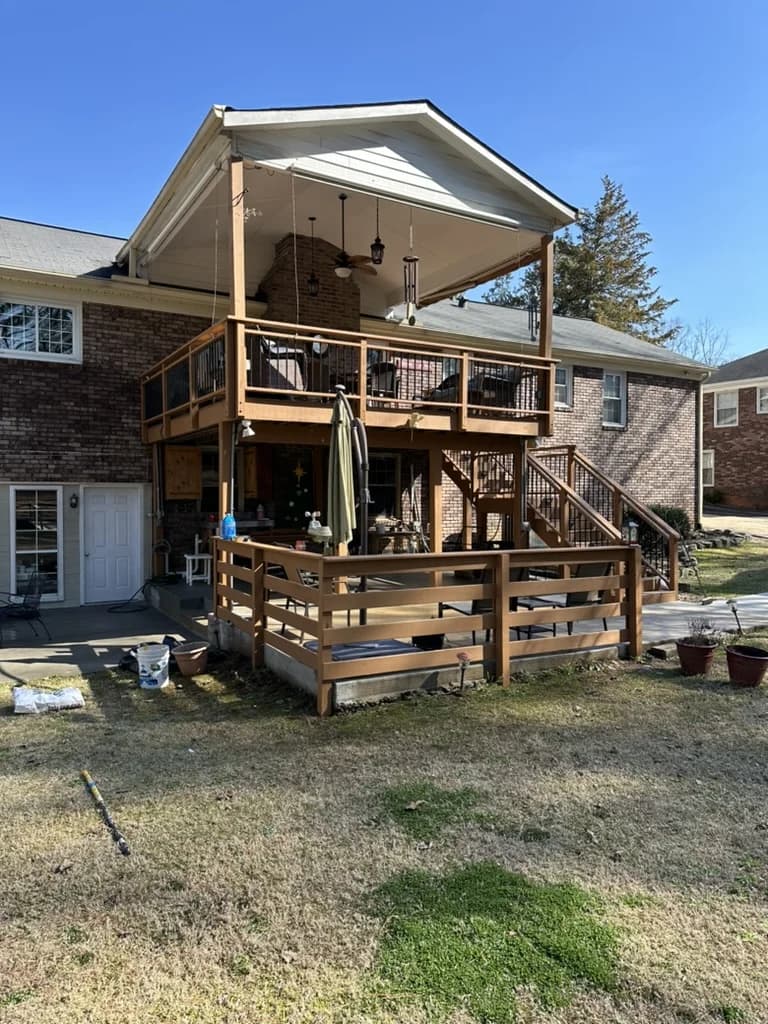
Georgia gives you roughly eight-plus usable outdoor months, and rain and mosquitoes take a bite out of them. Covering part of the deck fixes the first; screening fixes the second.
- A covered roof or porch extension runs $45–$65 per square foot installed — the most expensive line item here, and the one that changes how the space gets used the most.
- Adding a screened enclosure runs $9–$11 per square foot on top of the structure it encloses.
You don't have to cover everything. A common layout we build: half the deck open for sun and the grill, half covered or screened for dinner and rain. If you're weighing the full decision, see our comparison of screened porches vs open decks.
Putting a Budget to It
Every feature above sits on top of the base structure, which for a new pressure-treated deck runs $23–$30 per square foot installed, or $38–$53 for Trex/TimberTech composite. Full pricing from our actual jobs is in our Atlanta deck cost guide. We price everything cost-plus — our labor rate plus materials at actual cost through contractor accounts, with no markup on materials — so a written quote shows you exactly where each feature lands.
If you want to walk through which of these fit your lot and budget, reach out for a free written quote — usually back to you within 24 hours, and both of us (Jake and Blaise) are on every job.
Frequently Asked Questions
What deck features add the most value?
Usable space adds the most: covered or screened sections that extend the season, seating built where people actually gather, and lighting that makes the deck work after dark. Cosmetic upgrades like picture-frame borders cost little and make everything else look better.
How much does a hogwire railing cost compared to wood?
Hogwire runs $55–$85 per linear foot on deck runs ($65–$100 on stairs), versus $28–$60 per linear foot for wood railings with metal balusters. The premium buys an unobstructed view, so it's worth it on wooded or sloped lots and skippable when the deck faces a fence.
Do built-in benches replace the need for a railing?
Only on low decks. Any deck surface 30 inches or more above grade requires a guardrail under the building codes our local counties follow, and a bench doesn't satisfy that. On decks under 30 inches, a bench can define the edge nicely.
Is a covered deck worth the cost in Georgia?
Often, yes. At $45–$65 per square foot it's the priciest feature here, but Georgia's ~50 inches of annual rain means an uncovered deck sits empty a lot of evenings. Covering even a third of the deck keeps it usable through summer storms.
Can these features be added to an existing deck?
Some can. Privacy screens, lighting, railing swaps, and benches retrofit well if the frame is sound. Cascading stairs and roof structures usually mean reworking framing, which is worth a free deck inspection first to confirm the structure can carry it.
Explore Our Services
About the Author
Jake
Jake co-founded RBJ Contracting in 2018 with a passion for quality craftsmanship. With extensive experience in deck construction and home improvement, he oversees project management and client relations. Jake is dedicated to delivering exceptional results and ensuring every customer is 100% satisfied.